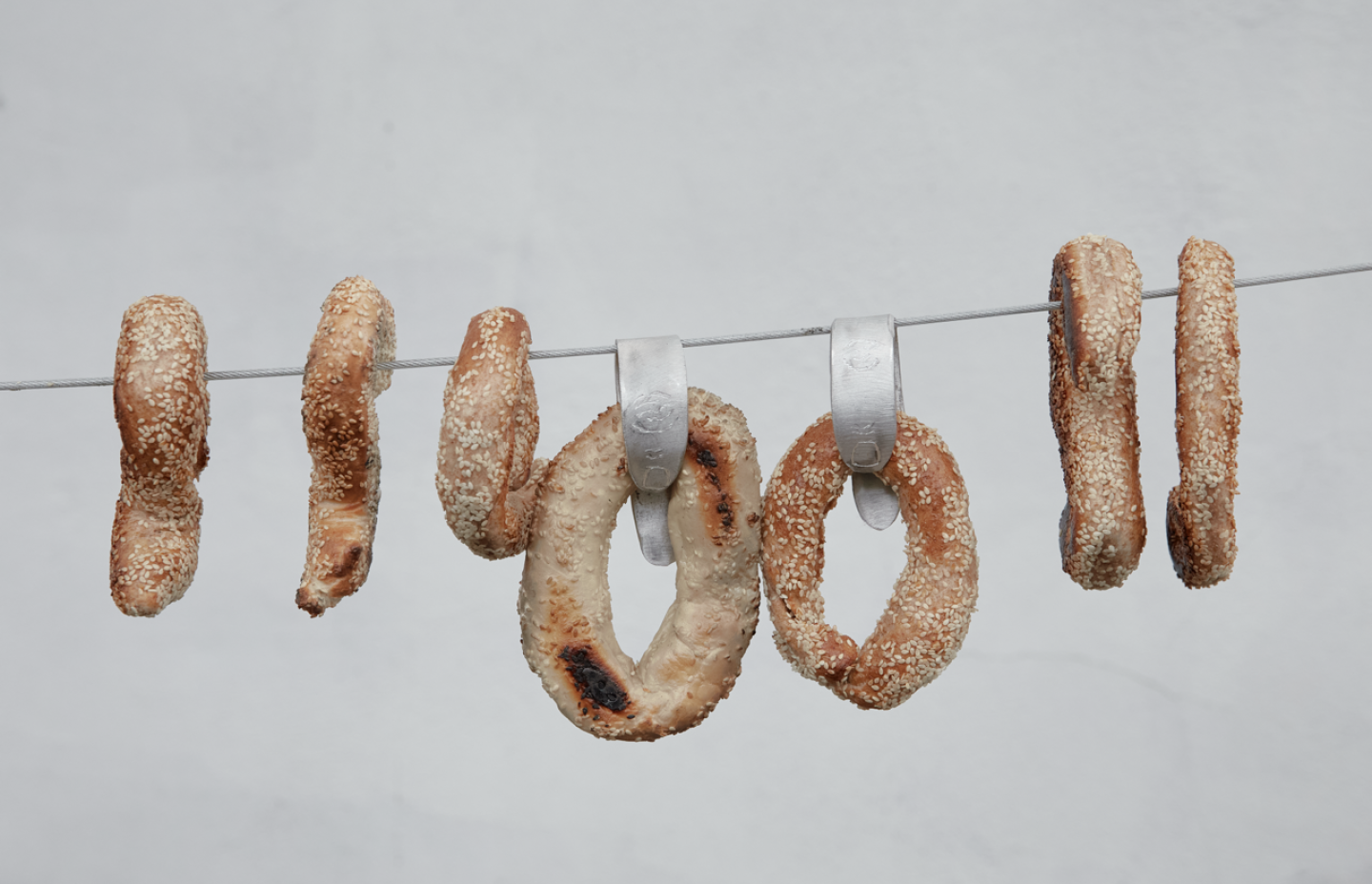
Photo credit : Alexis Bernard, courtesy of Centre Clark.
Feu de joie
Group exhibition
- Exhibition
This exhibition follows a cross-residency among the Conseil des arts et des lettres du Québec (CALQ), AXENÉO7, Nantes Métropole, and Le Lieu Unique (Nantes, France), as well as a collaboration with Centre CLARK, Atelier CLARK, and BONUS, Les ateliers d’artistes de la ville de Nantes.
With Feu de joie, Clélia Berthier invites Rose de la Riva, Rebecca Ramsey, Myriam Simard Parent, Manon Tourigny, and Amber Berson to take their place alongside her. Together, they present functional objects, tools stripped of their function, and forms inherited from everyday life. Through their relation to one another, these objects, like the practices of the gathered artists, carry collective and intimate memories of work, care, class, domestic labour, and gendered social roles. By attending to questions of use and utility, the exhibition opens a dialogue between what serves a function and what frees itself from it.
In C.B.’s work, roundness appears in the bagels, the oven, and the circle of people gathered together, while also echoing through bodies, mouths, bellies, cycles, and movement. The artist creates furniture-like structures with metal fingers that support both bodies and artworks: they foster forms of closeness, accompany the gestures of bread-making, and allow for shifts between inside and outside, between artwork and use, between sculpture and tool
This porous boundary between art and labour also shapes C.B.’s position. As a host, she extends invitations from within her own artistic practice, acknowledging the work of her peers. In this way, she recalls the first curators associated with the Ottawa Experimental Farm, whom Dr. William Knight, Curator of Agriculture and Fisheries at Ingenium, told us were themselves practitioners of the trade. They understood the work itself, not just the forms of the objects.
R.R.’s work turns formal research toward architectures of care, intimacy, and circulation. Through ceramics, she brings together pipes, organs, domestic networks, and mineral formations, revealing both the body and the built environment as fragile infrastructures. Her works suggest that care is not only a relationship but also a material system, shaped by passages and conduits.
With the zine Souper spaghetti, M.T. and A.B. carry this culture of sharing into the form of a recipe book. The work treats the recipe as a domestic and emotional archive, not just a set of instructions for preparing a dish, but a means of passing on gestures, memories, and relationships.
In M.S.P.’s work, this reflection on utilitarian objects is carved directly into wood. By recreating forms associated with everyday life and the domestic sphere, the artist unsettles the expected uses of a practice shaped by artisanal and gendered conventions. The objects she renders inoperative suspend their function without erasing the memory of it. They reveal tensions between art and craft, labour and domesticity.
In R. de la R.’s work, something unsettles the table. Certain nourishing materials appear not only as food or symbols of sharing, but as forms imbued with history. Through humour and symbolic gestures, her work introduces a sense of instability into the exhibition, where the act of nourishment is accompanied by a darker undercurrent, a witchlike memory. Presented during the opening, her performance will leave traces that will later become part of the exhibition.
Feu de joie invites viewers to see the exhibition as a space of activation rather than merely a site of display. For the opening, C.B. also presents a service-based performance in which acts of welcoming, preparing, and sharing food reenact the rituals of both labour and hospitality. This staging introduces a subtle irony… a slight displacement that keeps hospitality from settling into a seamless image of itself. For the artist, conviviality is not a matter of consensus but a space for experimentation.
While Feu de joie is now an administrative term referring to the permit required to light a fire outside the home, the title here evokes the image of a community gathered around a fire, recalling the long history of collective uses of fire as well as the gestures of preparation, nourishment, and coming together that surround it.
Clélia Berthier
Clélia Berthier is a visual artist based in Nantes, France. Her practice centres on installations and performative sculptures involving edible materials such as bread, corn and rice. She is interested in the actions and uses surrounding food, the forms this produces, and the experiences it generates. She completed a Bachelor’s and Master’s degree in Fine Art at the University of Rennes 2 before joining the École des Beaux-Arts de Nantes, where she obtained a DNSEP in 2019.
She joined the Ateliers Bonus in July 2021, received the City of Nantes Visual Arts Prize in 2023, was awarded a residency at the Centre d'art et de diffusion Clark in Montreal in 2024, and was invited by Bertrand Godot to hold her first solo exhibition at Le Carré Contemporary Art Centre in Chateau-Gontier in September 2025.
Rose de la Riva
Rose de la Riva is a visual artist and cultural worker born in Tiohtià:ke / Mooniyang / Montreal. Through a performative and multidisciplinary practice, her work spans performance, sculpture, installation, video and drawing. Seeking to develop a deeper, more nuanced and embodied understanding of history, she explores the foundations of our collective imaginations and the role of fear, economic instability and emotional vulnerability in the formation of magical beliefs. Creating a dialogue where formal and symbolic elements intertwine, her works sit at the intersection of the material and the immaterial, reflecting the nature of objects and their materiality.
Since 2016, her projects and performances have been presented in artist-run centres (Verticale, Le Lieu, DRAC, Skol, Fonderie Darling), galleries (Art Mûr), festivals (VIVA! Art Action, Festival des Faubourgs), residencies (LA SERRE – arts vivants, Atelier de l'Observatoire de Casablanca), apartments and derelict sites. She holds a Master’s degree in Studio Arts from Concordia University (2025).
Rebecca Ramsey
Originally from British Columbia, Rebecca Ramsey is an artist currently based in Montreal. She has a BFA from Emily Carr University (2017) and an MFA from Concordia University (2024). Using ceramics, her work reflects on overlaps between the circulatory systems of bodies and architecture. In 2023, she received a fellowship from the William Blair Bruce Travel scholarship for European research to visit ancient hygienic sites in Rome. Additionally, she has attended residencies at Guldagergaard, Denmark (2017), Medalta, Medicine Hat (2018, 2026), the Shadbolt Centre for the arts, Burnaby (2018) and Est Nord Est, St. Jean Port Joli (2025).
Her work has been exhibited at Projet Casa, Artch 5th Edition, the Canadian Clay and Glass Gallery, the Leonard and Bina Ellen Gallery, DRAC (Solo, 2024), Centre d'art et de diffusion CLARK (solo, 2025) and Nicolas Robert. She runs a small ceramic studio in Montreal dedicated to sculpture and teaching, in addition to teaching part-time in the Ceramics department at Concordia University.
Myriam Simard Parent
Myriam Simard-Parent is a visual artist who specialises in wood sculpture. She was born in Montreal and currently lives there. She creates her works using traditional craft techniques, such as direct carving and woodturning, as well as a variety of assembly techniques. Her works are made from native timber and recycled wood, and demonstrate a sensitivity to the different colours and textures inherent in the material. Through a stylised and humorous approach, Simard-Parent depicts and reinterprets elements from her daily life or drawn from memories: clothing, food, animals, etc. Through her practice, wood becomes a space for reflection on our relationship with objects, living beings, popular culture and the place they occupy within our identities.
Myriam Simard-Parent holds a Master’s degree in sculpture and ceramics from Concordia University and has presented her work in numerous solo and group exhibitions in Canada, France and the United States. Her recent solo exhibitions include Parc à chiens at Caravansérail (Rimouski, 2024) and Mai(s) encore at Collectif Bonus (Nantes, 2024), following a creation residency. She is currently in residence for a period of eight months at the Musée d’art contemporain de Montréal as part of the ‘Habiter le MAC’ programme.
Manon Tourigny
Manon Tourigny was born, lives and works in Tio’tia:ke / Mooniyang / Montréal. She holds a Master’s degree in Arts Studies from UQAM and works as a curator and author. In 2024, she published the story Il était un lac au rat musqué, illustrated by the artist Fanny Mesnard (L’Écart, Rouyn-Noranda). For the past 20 years, she has been involved in the visual arts community, notably at VIVA! art action, DARE-DARE and the Centre CLARK. She is currently studying creative writing part-time at UQAM, serves on the board of directors of REPAIRE and holds the position of General and Artistic Director at Artexte.
Amber Berson
Amber is currently the Executive Director of The Visual Arts Centre in Montreal. Amber Berson is a writer, a curator, and an Art Historian. She holds a doctoral degree from Queen’s University where her SSHRC-funded research examined artist-run culture and feminist, utopian thinking. In her spare time, Berson works on knowledge equity projects, especially with the Art+Feminism Wikipedia project, where she worked in various capacities for a decade and now sits on the Board. Furthermore, she was the 2019-2020 Wikipedian-in-Residence at Concordia University Libraries. In addition to her curatorial work, Berson’s writing has been published in a variety of publications, including Canadian Art, C Magazine, Revue .dpi, Esse, Fuse Magazine, M/Other Voices, Vie des arts, The Creative Independent and the St Andrews Journal of Art History and Museum Studies.
Partners