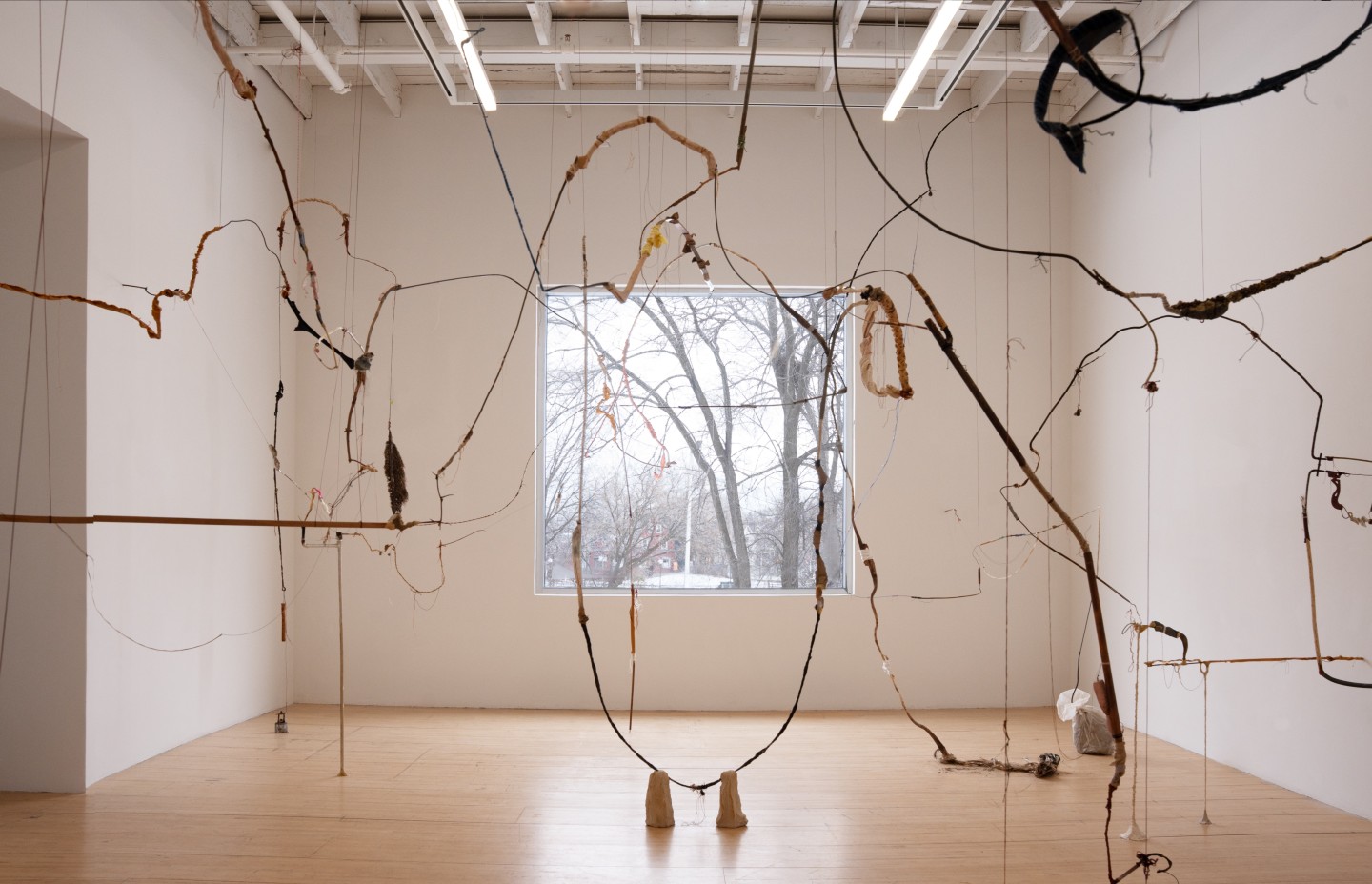
Installation view, Le ver creuse ses tunnels dans La pomme par laquelle je bois, Maude Arès, 2026. Photo: Emma Jacques.
Le ver creuse ses tunnels dans La pomme par laquelle je bois.
Maude Arès
- Exhibition
Presented as part of AXENÉO7’s winter programming, Le ver creuse ses tunnels dans La pomme par laquelle je bois occupies all three gallery spaces of the centre and results from the PRAXIS residency program.
Free admission
Free parking
As we enter the matter
From the backstage of this work, writing about the actions carried out is less about recounting how they unfolded than about following their persistences and transformations.
As the fruition of the PRAXIS program, this exhibition is a retrospective journey through a continuing collaborative process that the artist has been pursuing with matter and material for over a decade.The collection that accompanies it comprises fragments, scraps, and found objects, gathered over the years and reappearing time and again in different projects.
Held in three rooms, Le ver creuse ses tunnels dans La pomme par laquelle je bois thus gives shape to the physical, formal, and temporal convergence of an artistic approach, a practice, and a collection.
Neither a beginning nor an end, the exhibition offers a transience of what remains ongoing: a space of focus where past actions, present materials, and future possibilities are brought together, mingle, and entwine.
Le ver [The Worm]
Stems, materials gathered and assembled, suspended and arranged forms: as it infiltrates and spreads, this aerial network—which feels as much like a mesh as it does a circulatory system—invites us to slow down and pay attention to both its proximities and convolutions. Following, our gaze can trace the path of its ligatures and mutations.
Something, here, persists, lingers, surfaces, without ever fully revealing itself.
Another scene then opens. In this invisible mythology, the figure of the worm does not appear merely as a motif, but as a principle of creation and, further, of interpretation. The worm evokes an underground progression, a quiet, burrowing process, an advance through branching, forking, and breaches. It does not impose an order; it eases a passage.
Lieur [Linker] — or, as Maude suggests, «that friend who links» —, the worm acts as a subtle connecting force, emerging between forms to make their relationships perceptible. Rather than an isolated figure, it reveals a way of approaching the exhibition, both in the details of its individual sequences and, in its overall unfolding. This unifying force weaves through the exhibition space; the elements there seem to respond to one another according to an organic, sensitive, almost synaptic logic.
La pomme [The Apple]
Like concentric circles, the exhibition and performative installation titles are nestled within the same heart with La pomme par laquelle je bois. La pomme becomes the centre, the core from which the project unfolds, deepening and imbricating its successive layers. Although it invites us into its heart — to the main stage — the piece does not place us in front of a fixed centre. Rather, it draws us into a realm of interconnections where matter answers matter; where forms brush against one another; where fragments present contrasting fragilities: where their coexistence becomes a vehicle for narratives and transmission. At the centre of this lattice, La pomme does not act as a physical incarnation, but as a hollow space, riddled with passages and tunnels, through which something moves, is held and is bound. Thus, seeking the heart does not mean going straight to the centre, but rather observing what, from within, is already working its way outward.
Le temps [Time]
Far from being a mere collection of personal archives, the exhibition is a prolongation of a long-term creative process, in which the studio shifts to expand into the exhibition space itself. Time works quietly there. It passes through matter, settles within it, leaves its mark on surfaces, and inflects its states. Unbound from its boxes and cases, the collection unfolds throughout the space; fragments, debris, and found objects continue to move, transform, and reappear in new relationships. Time slows down while the elements continue to play their part. Inventory is not just about conservation, but about letting time do its work and observing, from one phase to the next, how the materials continue their own processes.
The exhibition brings into focus the gentle activity which sees an object come into being and persist. Each element holds within it several durations: those of gathering, care, movement, and arrangement, but also holds temporalities that go beyond the limits of the studio and sequencing of the exhibition. Every area, every fragment is permeated by its own experiences, stories, and transformations. What we experience is not a finite composition, but states of being shaped by the passage of time, to which we bear witness.
— M.A. Marleau
Translated from the original French by Coco Simon Finken, with assistance from DeepL.
Maude Arès is an interdisciplinary artist. Working primarily through installation, her practice extends into sculpture, performance, scenography, and drawing. Her work explores sensitive relationships between found materials, creating vulnerable environments that invite close attention to the subtleties of tangible worlds. She reflects on the performative qualities of materials and the gestures that animate them, seeking to reveal visible and invisible interdependencies between humans and non-humans. Her projects have been presented in artist-run centres, theatres, and various events in Canada and Colombia.
Acknowledgements
Maude Arès wishes to thank Simon Labbé and Erin Hill, with whom this project developed through a close and trusting collaboration, shaped by friendship, generosity, and a shared commitment to La pomme par laquelle je bois. She also thanks Guillaume Houët and Catherine Fournier-Poirier for their support in the development of the lighting design. Thanks to Mia Guertin-Crête for her precious help with the worm’s twists and turns. Thanks to Philippe Lauzier for his powerful clarinet playing.
She would like to acknowledge the contributions of Fanny Brossard-Charbonneau, Isabelle Darveau, Geneviève Philippon, Élise Anne LaPlante, and Dominique Rivard for the precision of their words, the quality of moving images, and the spirit of collaboration that enriched the creative process. She also thanks Daniel Pelchat, Rebecca Rehder, and Frédérique Roy for their sensitivity and attentive presence throughout the project.
She thanks the AXENÉO7 team and the Recto-Verso residencies for their generous welcome and commitment to this coproduction, which enabled the project to unfold and take shape.
Finally, she wishes to thank the Conseil des arts et des lettres du Québec, the Canada Council for the Arts, Atelierhaus Salzamt (Austria), and KUNSTSAMMLUNG(Austria) for their support. This project received financial support from the Canada Council for the Arts and the Conseil des arts et des lettres du Québec through the Explore / Create and Production programs, as well as support from AXENÉO7, which made possible new ways of sharing artistic practice with the public.
Partners