La pomme par laquelle je bois
Maude Arès + Erin Hill + Simon Labbé
- Performance
Approximate duration of 45 minutes, with no intermission. Late entry will not be permitted once the performance has begun. Seated performance. For accessibility inquiries, please contact us.
Performance #1 | Feb. 20, 2026 | 6:00 p.m.
limited capacity — reservations recommended
Performance #2 | Feb. 21, 2026 | 4:00 p.m.
limited capacity — reservations recommended
Performance #3 | Feb. 21, 2026 | 6:30 p.m.
limited capacity — reservations recommended
Performance #4 | Mar. 27, 2026 | 6:00 p.m.
limited capacity — reservations recommended
Performance #5 | Mar. 27, 2026 | 8:30 p.m.
free admission — subject to venue capacity
Performance #6 | Mar. 28, 2026 | 4:00 p.m.
limited capacity — reservations recommended
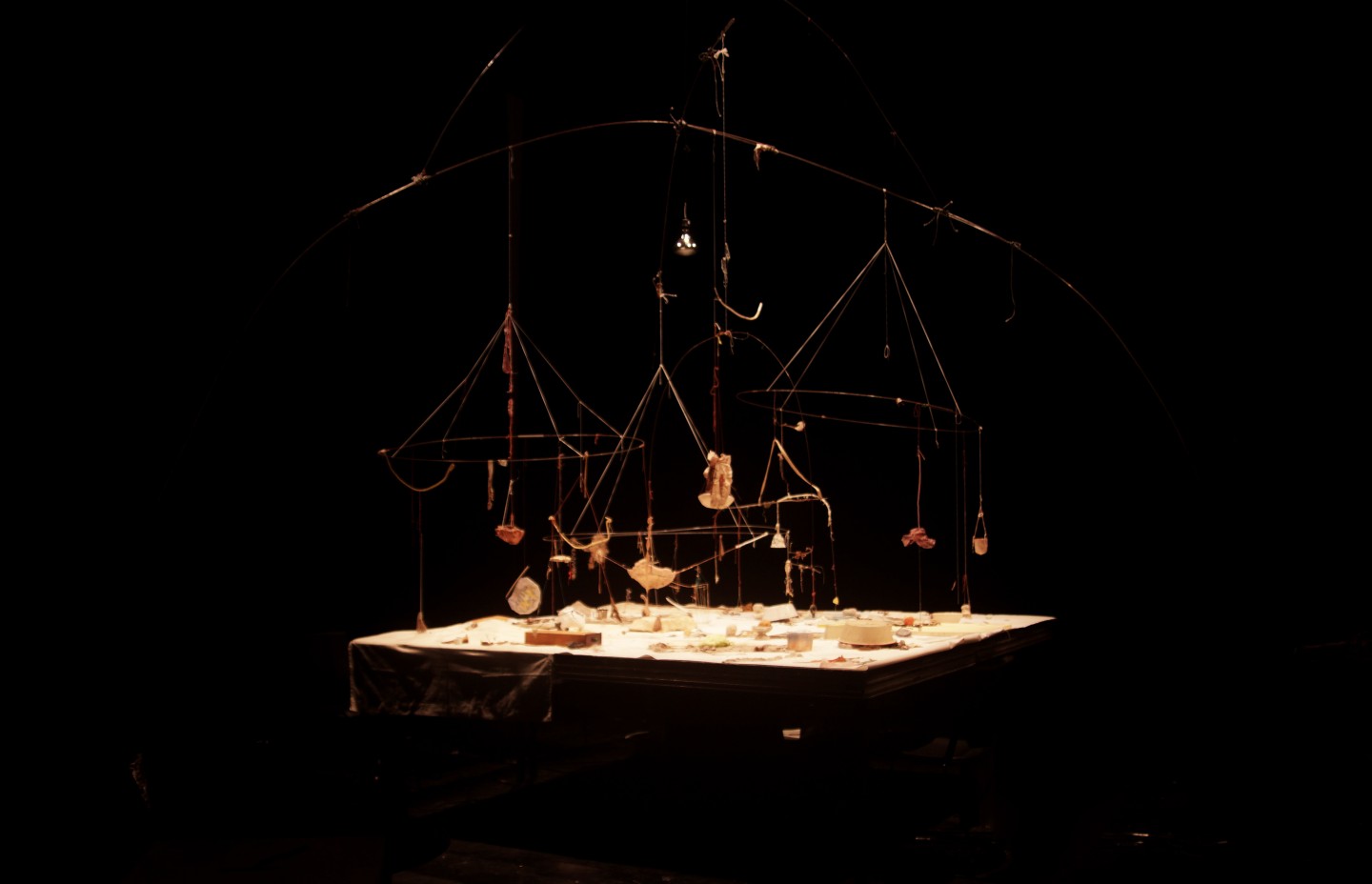
In collaboration with Simon Labbé and Erin Hill, we are developing a performative installation that stages micro-events within an amalgam of materials. La pomme par laquelle je bois celebrates material modes of existence. At the center of the space is a large mobile, beneath which stands a tableau-as-table. Some materials rest on it, while others float in the air. The performance is not that of humans, but of the materials.
The Danube, in its rippling lacework, calmly circles the turbulence of its silk threads. The air suits it. With simple knots, a halo hovers above it, holding it in suspension. Not far away, the ball bearing has settled on the paper. Its weight is what slows the orchestra’s circulation. It is the anchor that rolls from the vessel (of) immortals. Before it comes to rest, it met the striped-straw-lid-flattened-by-car-tires. At the rope’s elbow, the wheel lifts the brew, only to abandon it on the canvas. The wheel, tied with the thread from Camille’s unstitched sleeve, continues—hesitantly—on its path. In its bounces, it tangles with the long blond loop that has just shifted a few grains of iron-rich sand. Together, they caress the soap-dome (the dry soap) and draw near the fibres of the unrolled bandage.
In observing a fragment, a kind of “material reverie "¹ is set in motion, inviting us to imagine the missing part of the objects before us. Where do they come from? What paths have they taken? What were their functions? What are they made of? To contemplate the state of their presence—the scars that shaped them and the promises of what they might yet become—and then to feel what they stir within us: a memory, a feeling, a sensation, a symbol. Through these back-and-forth movements between concrete activities and imaginative (or memorial) eruptions, a dramaturgy, one I call a dramaturgy of proximities, is woven.
The grommet that held the boat makes the rectangular bottle—beloved by its drinker—ring out. He kept it close to his body, pressed to his right hip to warm its contents on cold days. The boat’s grommet meets the corner of the drinker’s bottle. It sways. Suspended. Then it continues, sliding along the bottle’s side edge. A hand has been shaped by the glove of his work. The glove is dirty—its dirt united with the task. Thorns are tied, forming a bouquet of thorns; by his ear is a loop, from whose end milky owls dangle. It was for festive evenings that the milky owls brushed the neck. At the end of the night, it returned to the dark case, kept near the bed.
This performance unfolds as an invitation to intimacy, bringing bodies, gazes, and materials into closer proximity to open a space of attention where even the slightest contact matters. It’s about slowing down, listening to what’s taking shape between things, and recognizing the presences that wait to be seen.
¹ Bachelard, G. (2004). “La terre et les rêveries du repos.” Mayenne : Librairie José Corti.
Acknowledgements
Maude Arès wishes to thank Simon Labbé and Erin Hill, with whom this project developed through a close and trusting collaboration, shaped by friendship, generosity, and a shared commitment to La pomme par laquelle je bois. She also thanks Guillaume Houët and Catherine Fournier-Poirier for their support in the development of the lighting design. Thanks to Mia Guertin-Crête for her precious help with the worm’s twists and turns. Thanks to Philippe Lauzier for his powerful clarinet playing.
She would like to acknowledge the contributions of Fanny Brossard-Charbonneau, Isabelle Darveau, Geneviève Philippon, Élise Anne LaPlante, and Dominique Rivard for the precision of their words, the quality of moving images, and the spirit of collaboration that enriched the creative process. She also thanks Daniel Pelchat, Rebecca Rehder, and Frédérique Roy for their sensitivity and attentive presence throughout the project.
She thanks the AXENÉO7 team and the Recto-Verso residencies for their generous welcome and commitment to this coproduction, which enabled the project to unfold and take shape.
Finally, she wishes to thank the Conseil des arts et des lettres du Québec, the Canada Council for the Arts, Atelierhaus Salzamt (Austria), and KUNSTSAMMLUNG(Austria) for their support. This project received financial support from the Canada Council for the Arts and the Conseil des arts et des lettres du Québec through the Explore / Create and Production programs, as well as support from AXENÉO7, which made possible new ways of sharing artistic practice with the public.
Biographies
Maude Arès
Maude Arès is an interdisciplinary artist. Working primarily through installation, her practice extends into sculpture, performance, scenography, and drawing. Her work explores sensitive relationships between found materials, creating vulnerable environments that invite close attention to the subtleties of tangible worlds. She reflects on the performative qualities of materials and the gestures that animate them, seeking to reveal visible and invisible interdependencies between humans and non-humans. Her projects have been presented in artist-run centres, theatres, and various events in Canada and Colombia.
Erin Hill
Erin Hill is a dance artist, writer, and birth support practitioner. Hill’s work is rooted in daily practice, building relations with ecological protagonists such as the sun (Sunrise Commitment, 2018) and the weather (Deep Gazing, ongoing). Erin is one half of The Sisters of the Celestial Order of Nephology, co-created with lifelong collaborator Nina Vroemen under the name Horizon Factory. More recently, Erin’s practice is engaged by the nuances of beyond verbal communication in interspecies relationships, for which she is pursuing a PhD in Humanities at Concordia University. As a dramaturg and writer, Hill has worked with dance artists Sebastian Kann, Lucy M. May, Charlie Prince, Camille Lacelle-Wilsey, among others. Erin holds a Master’s degree from DAS Theatre (formerly DasArts) in Amsterdam and makes home as a settler in Tiohtià:ke / Mooniyang / Montreal.
Simon Labbé
Simon Labbé develops a hybrid practice centred on the gesture of listening, articulated through composition for performance, installation, writing, recording, and interventions in public space. He is particularly interested in the situated nature of listening and the spaces it unfolds. His work investigates and activates environments and the trajectories that compose them through field recordings, scores/choreographies, and spatial dispositifs.
His work has been presented locally and internationally in Mexico (Cubo), Berlin (Sacred Realism), Brussels (Q-O2), Amsterdam (DNK Days), Klagenfurt (Lakeside), and Boston (Co-incidence). He has received support from the Canada Council for the Arts and the Conseil des arts et des lettres du Québec on several occasions and has participated in numerous residencies in Canada and abroad. Simon Labbé lives and works in Montreal.
Partners