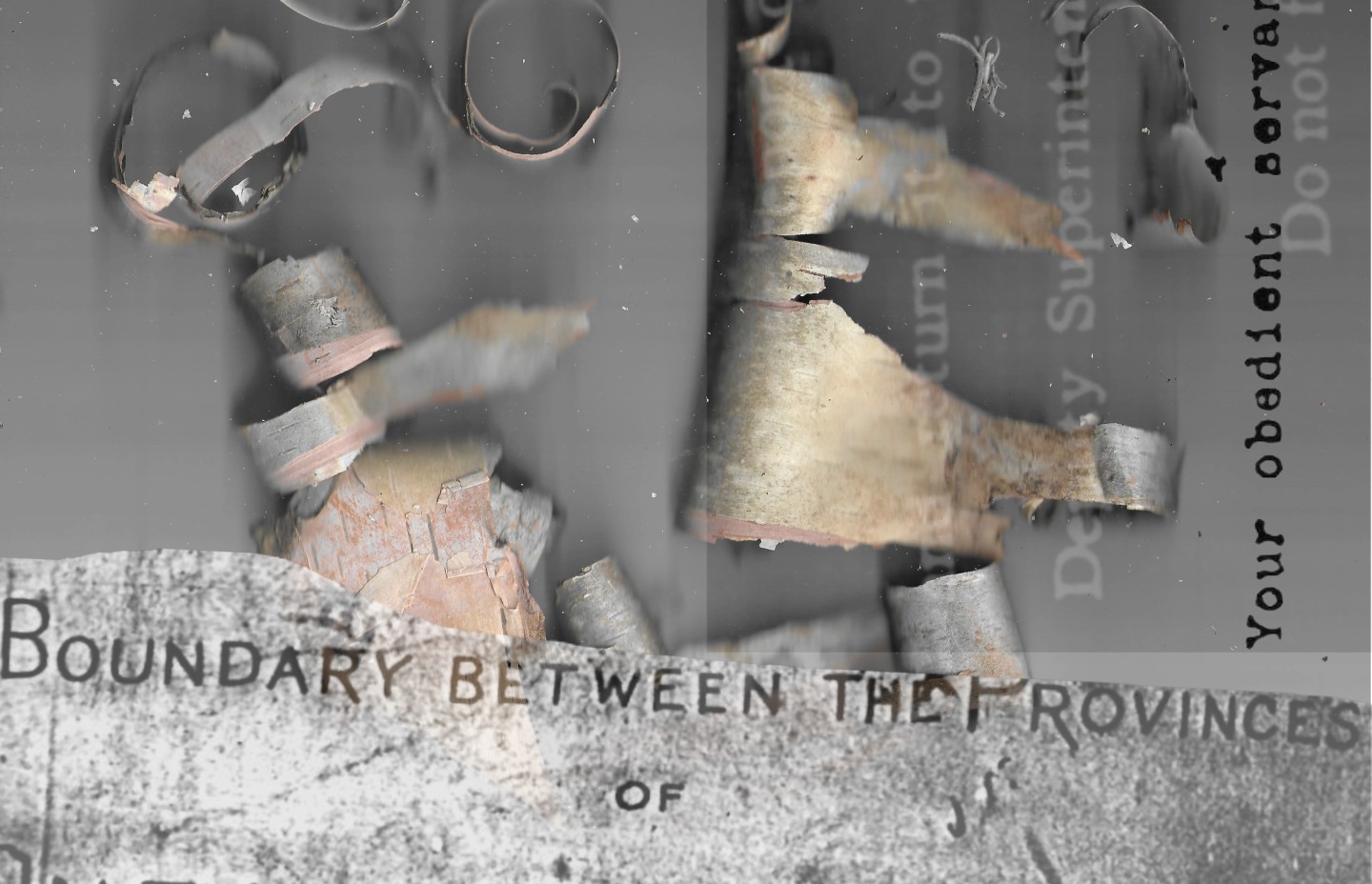
Photo credit : Dominic Lafontaine
Les Enfants des bois
Dominic Lafontaine
- Exhibition
Free admission
Free parking
Bicycle path nearby
STO bus stops at one-minute walk
The exhibition Les Enfants des bois began to take root a few years ago, during the first iteration of RED INK ENCRE ROUGE, an exhibition that subverted AI generators to conjure up “pretendians.” It was then that I was invited to create a work for AXENÉO7 in which Indigenous art would meet technology, in the midst of that strange era of virtual residencies.
After those uncertain years spent at a distance, I could finally begin my first in-person residency, here at AXE. I was delighted to return to a physical place, to walls, to a sense of presence. This exhibition grew out of the encounter between my work as a digital archives technician for the Algonquin Nation Secretariat and my somewhat “trickster” way of inhabiting AI and its tools, turning them around, making them speak differently.
Through ongoing conversations with M.A., an idea took hold: to create a treaty for a single square foot of the gallery. Gatineau stands on the unceded territory of the Anicinabeg, my tribe. It therefore became “necessary” to follow the logic of territorial cession to its conclusion or, in the case of the Outaouais, that of colonization advanced through bureaucratic banality. If there is no treaty, it is also because it was more convenient for the Canadian government to defer recognition, and then the dream of repatriation, right up to the present day.
My community, Timiskaming First Nation, remains engaged in negotiations over land claims. I wanted to tell the story of this waiting and persistence through large digital collages. Archival fragments, mostly the words of bureaucrats and “Indian” agents, meet images of the land, of the Kitchi-Sipi, and of the raw material that runs throughout the exhibition: bark.
Birch bark is its anchor: an anchor without ink, Anicinabe papyrus. To me, it is the analogue of a paper receipt: the trace of an exchange, the memory of an agreement, the fragile proof that something was lived. The treaty, printed on this paper, wraps around the space like a long list of promises left hanging and questions never resolved.
While creating the treaty, the AI agent actually produced an agreement that bound more than just the artist and AXENÉO7, the gallery. It had also named the Square Foot as a signatory: no longer simply a place, but a partner. A small parcel of land suddenly endowed with a voice and a seat at the table. Very progressive, I must admit.
In Les Enfants des bois, I invite the public to look at the birch as a living motif: a skin marked by experience, streaked with scars. Its bark is also kindling, a highly flammable material. And yet it remains a form of official paper destined to decompose, a natural archive entrusted to time.
Dominic Lafontaine
Dominic Lafontaine is an Algonquin multimedia artist, essayist, and musician. His bold, witty, and
often absurd works examine the ideas of cultural identity, meaning, and belonging. A graduate of the
Visual Arts program at the University of Ottawa, he brings together traditional art forms and new media
to reimagine the visual language of contemporary Indigenous art. His motto: «Research, remix and
repeat!»
Partners